Compare
memoQ manages the project. The document still has to be rebuilt.
Project management, terminology and the translator workspace are the parts of this category that work. The part that does not is what happens to the file.

What it is good at
Project structure and assignment are mature. A project manager can see where work stands without chasing people.
Terminology management is a first-class feature, not an afterthought. Term bases are the kind of thing this category does properly.
The translator workspace is what translators expect. Whatever an agency adopts, it has to survive contact with the people doing the work.
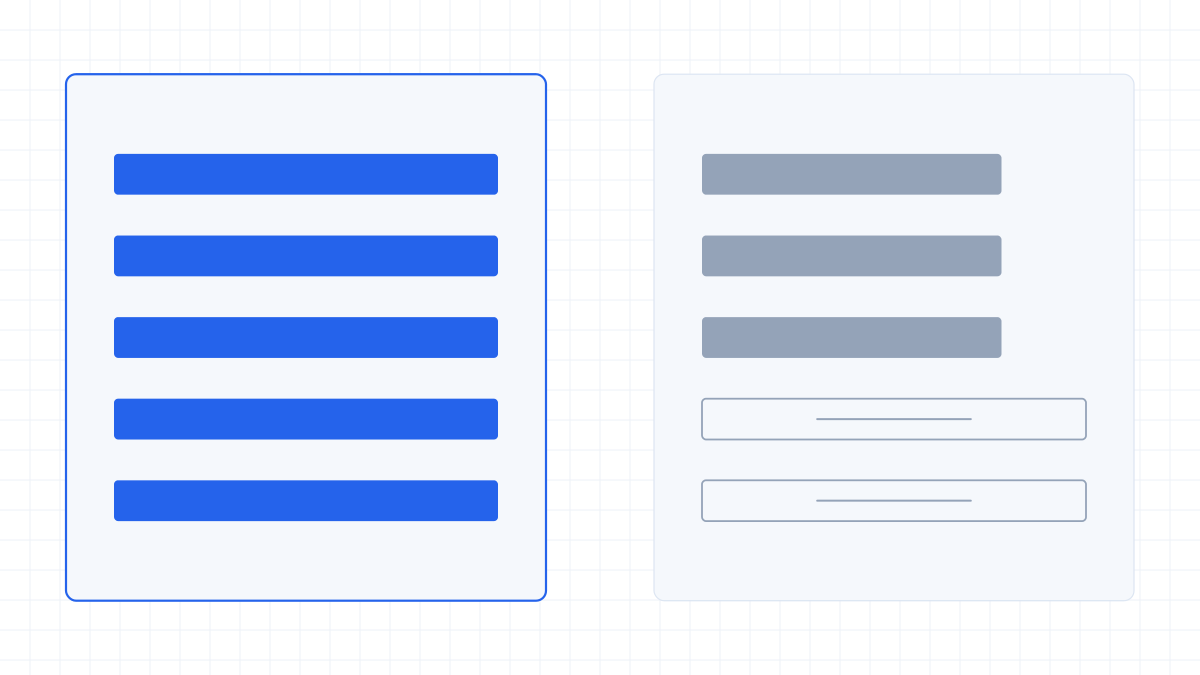
Where the document itself is left to you
These are the gaps our pipeline exists to fill. They are about the file, not about the tool.
Format round-tripping is fragile
Converting a design-heavy file into a segment format and back is where layout quietly degrades — spacing, text-box fit, numbering.
Scanned content has no segments
Nothing to segment until recognition has run, and in a mixed PDF that is a decision per page rather than per file.
Reassembly is engineering work
Rebuilding a .docx or .pptx around translated segments is a different problem per format, and it lands on whoever has the least time.
Quality checking happens after delivery
Layout problems are not visible in a segment view. They become visible when the client opens the file, which is the most expensive moment to find them.
Capability comparison
Categories, not vendors. We do not publish anyone's pricing, including our own.
| Row label | Us | Raw MT / cloud translation APIs | TMS platforms |
|---|---|---|---|
| Multilingual | Configured to your markets | A fixed list | A fixed list |
| Format preservation | Layout written back in place | Text or a rough file | Not an engine |
| Per-page processing plan | Each page routed on its own | One call, no quality control | Manual workflow |
| Multimodal input | Five source classes, five paths | Mostly text only | No |
| What you receive | Finished files | A block of translated text | Process management |
| Who owns the quality | Us | You | You |
How this sits next to memoQ
Two layers, both doing their job.
The document pipeline runs through us and returns a finished file. Project management, assignment and terminology stay where they are.
Terminology is the interesting overlap, and it is not a conflict: your term base stays your system of record, and we take a glossary for a specific job — up to 2000 terms — and enforce it during translation.
Nothing about the workflow changes for the people doing the work. What changes is that the file arrives already assembled.
Questions
Do we need to move off memoQ?
No. The document pipeline runs alongside it. Your project management, assignment and term base stay where they are.
Can you use our term base directly?
We take a glossary in TXT, CSV or XLSX — up to 2000 terms — per job. If your terms need to be read from another system, that is scoping work.
How does this handle scanned documents?
Pages without a text layer go down the optical recognition path, and in a mixed PDF that decision is made page by page rather than for the whole file.
What happens if the layout breaks?
The pipeline checks the rendered output against the source before delivery. What still gets through, you can mark and have reprocessed on its own.
Do we have to change our review process?
No. The document arrives translated and assembled; your reviewers work in the environment they already use.
Send us a document that normally needs rebuilding.
One file, run end to end, returned finished — so you can judge the reassembly step you would otherwise be doing by hand.
- No signup, no self-service portal — you send a file, we run it.
- You get the finished document back, not a screenshot of one.
- If it is not good enough, you have lost nothing.