For translation agencies
More volume through the same team. Without hiring machine operators.
You already know a model can translate a sentence. What slows you down is everything around it: files that come back broken, terminology that drifts, one awkward page that stalls a whole delivery. That is the part we handle.
Most agency engagements start with one sample file.
What usually hurts
These are the four problems agencies bring to us. If none of them is yours, we are probably not the right fit.
The file comes back wrong
Layout shifts, broken tables, a header that no longer fits. Someone has to fix it by hand, and that someone is usually your most expensive person.
Volume does not scale with headcount
Taking on more work means more project managers supervising machines. The margin disappears into coordination.
Terminology drifts
You have a term list. The output does not respect it consistently, so a reviewer has to catch every instance by hand.
Nobody trusts the output
So everything gets reviewed end to end anyway. If a human has to check every line, you have not saved anything.
How an engagement usually runs
Four steps, in this order. We do not skip to the third one.
- 01
You send one real file
Not a sanitised example — the awkward one. A scanned page, a chart-heavy deck, whatever normally causes trouble.
- 02
We run it end to end
Same path your production work would take: inspection, routing, translation, term enforcement, and the independent visual check.
- 03
You judge the output
Open the file. Look at the layout, the terminology, the pages that usually break. That is the whole evaluation.
- 04
We scope the engagement
Volume, language pairs, turnaround expectations, how it connects to your existing tools. Scope is a conversation, not a form.
What you can hand us
The capabilities below are running today. They are not roadmap items and they are not self-service buttons — each engagement is scoped.
Document batches
Up to 50 files in one submission, up to 1000 pages per PDF. If a batch is interrupted, it resumes from the last completed page instead of starting over.
Format-preserving write-back
PDF, DOCX, PPTX, XLSX and the older Office formats, plus image input. Translated text goes back into the original layout.
Glossary enforcement
TXT, CSV or XLSX term lists, up to 2000 terms per glossary, applied during translation rather than as a post-pass.
Mixed and scanned documents
A PDF that is part digital, part scan is treated as its own case. Pages are classified individually, not the file as a whole.
Region-level repair
When one area is wrong, you mark that region and choose: restore the source, retranslate it, or keep it. Only that region is reprocessed.
Independent quality check
The visual and quality check runs on a different model from the one that produced the translation. It does not grade its own work.
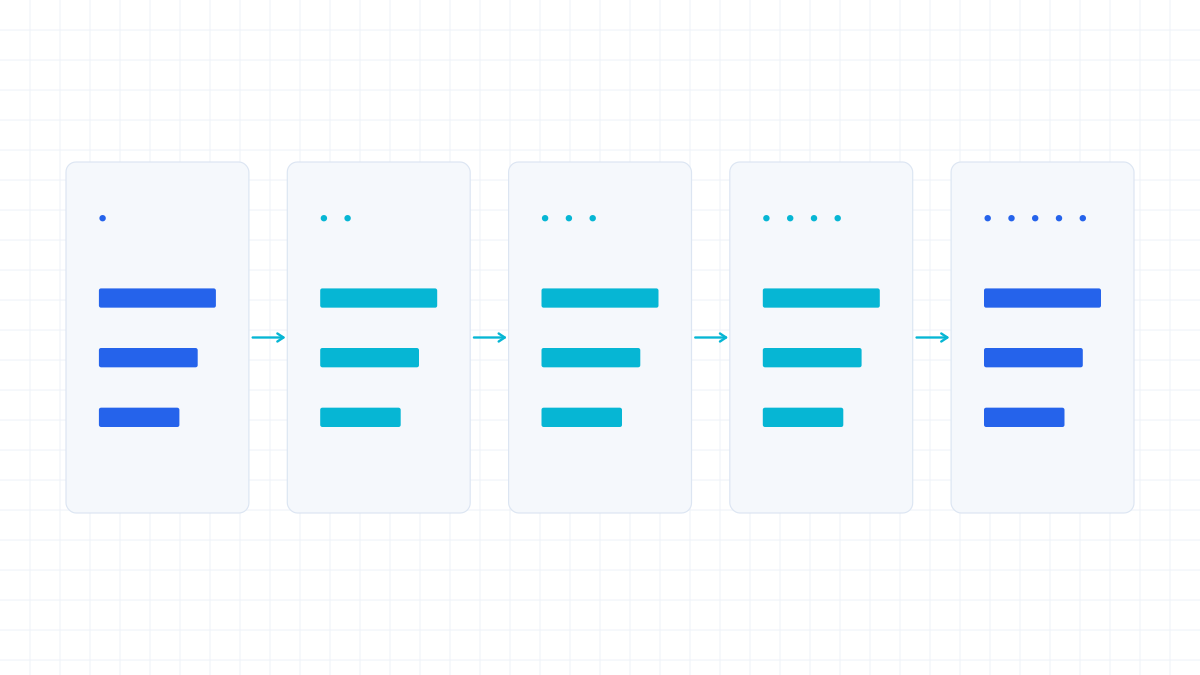
Where this fits in your stack
We are not asking you to drop your CAT tool or your TMS. Most engagements run alongside them.
The usual shape: your project managers keep working where they work, and the document pipeline runs through us instead of through a raw translation API that returns text.
Where your system needs to call us directly, we scope that as integration work — see the integration page for the kinds of connection points we support.
If you want the capability inside your own infrastructure instead, that is a separate assessment.
Agency questions
We already use a CAT tool. Is this a replacement?
No. It runs alongside it. The common pattern is that the document pipeline goes through us and the review and management stays where it already is.
How do you handle our client's glossary?
You upload it as TXT, CSV or XLSX — up to 2000 terms per glossary — and it is enforced during translation. If your terms live inside another system, tell us where and we will work out what reading from it takes.
What about a document that is half scanned?
That is a normal case, not an edge case. Pages are classified one at a time, so the digital pages and the scanned pages take different paths within the same file.
Can we see it work before committing?
That is what the sample evaluation is. Send a real file, we return the finished document. There is no trial account because a trial account would not show you the part you actually care about.
What if only part of a page is wrong?
You circle that region and pick what to do with it: restore the source, retranslate it, or keep it as it is. Only the marked area is reprocessed.
Do you work under our confidentiality terms?
Terms are set per engagement and we do not name clients. Talk to us about what your clients require and we will tell you plainly whether we can meet it.
Send us the file that usually causes trouble.
That is the whole evaluation. One document, run end to end, returned to you finished — so you can judge the layout, the terminology and the pages that normally break.
- You send a real document
- We run it and return the finished file
- You decide what happens next